


Space spray fundamentals
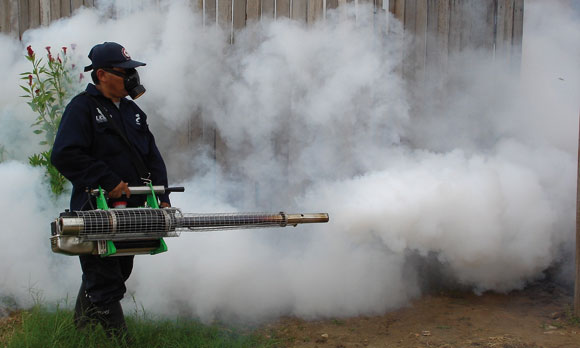
Hand carried thermal fog with oil based formulation
Control of flying insects in a stored product environment is always a challenge. Owners of large warehouses often prefer a non-residual space treatment instead of spraying wall surfaces with a residual insecticide. The aim of a space spray is to control flying insects with very small droplets penetrating between stacks of produce. Control of insects in buildings in this way was a key application method over 80 years ago when natural pyrethrins were atomized into a fine spray using a twin fluid compressed air “paint” sprayer.
A flow of air through the nozzle sheared the spray liquid into sufficiently small droplets that remained airborne long enough to kill any insects active in the treated space. Original hand held devices included the “Flit-gun”, a small hand operated applicator that was eventually replaced by an aerosol can for domestic use.
Post World War II, thermal fogging equipment originated from two sources. In one form, equipment that had been developed to screen warships from attack was adapted to apply insecticides. The Todd Insecticide Fog Applicator (TIFA) is one example of a truck or trailer mounted fogger with a large heat exchanger that is used to disinfecting ships holds, sewers and for treating grain. Alternatively, hand carried thermal fogging machines, evolved from the pulsejet engine, and were really a development from the V1 rocket engine design.
This is a preview of a full article published in International Pest Control – March/April 2013 issue.
View full article online
The full text of this article is available to subscribers of International Pest Control.
Subscribe for online access
Subscribe to International Pest Control for full online access to all articles in every issue since 2004.
Author: Graham Matthews
IPARC Imperial College, Silwood Park, Ascot, United Kingdom
Category: Public health