


Second attempt to eradicate OPM by aerial spraying
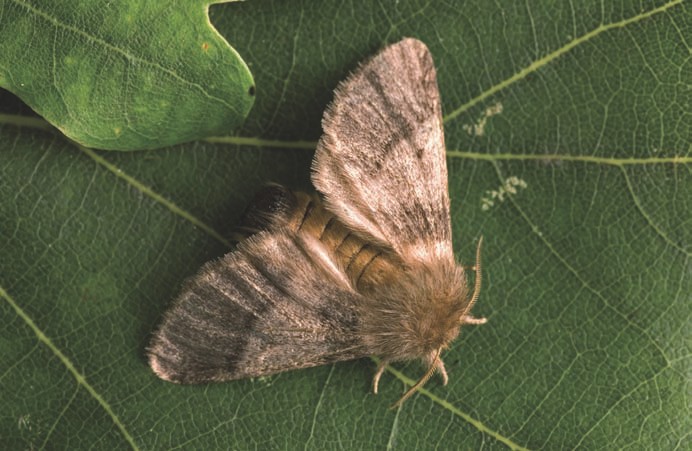
Male oak processionary moths are strong flyers with flight capability distances of up to 25 km (Picture: Forestry Commission)
Aerial spraying of insecticide which took place over West Berkshire, United Kingdom (UK) in May 2013 against oak processionary moth (Thaumetopoea processionae) (OPM) will be repeated in May 2014 said the Forestry Commission (FC) in a surprise snap announcement on 1st May 2014.
Given the furore created by last year’s aerial application of the biological insecticide Bacillus thuringensis subsp. kurstaki (BTk) over woods near Pangbourne, this year’s campaign on nearby woods which are also a SSSI (Site of Special Scientific Interest), appears strange to say the least; especially since no OPM nests were found in 2013. The action is apparently based on the capture of five male adult moths in late summer 2013 during a routine pest monitoring exercise with pheromone traps.
The FC says this does not necessarily mean a viable breeding population of OPM is still present in the Pangbourne area but that their aim is still pest eradication. This begs the question as to why another round of aerial spraying is planned, when last year’s operation clearly failed to ‘do the trick’. Last year FC admitted they were unsure as to whether there were actually any pest insects in the treated woodlands.
This is a preview of a full article published in International Pest Control – May/June 2014 issue.
View full article online
The full text of this article is available to subscribers of International Pest Control.
Subscribe for online access
Subscribe to International Pest Control for full online access to all articles in every issue since 2004.
Author: Dr Terry Mabbett – Technical Consultant – International Pest Control
Category: Agriculture