


International pest news in brief – July/August 2013 issue
-
USA: New Jersey man sets fire to home trying to remove bedbugs
After reading that high temperatures can kill bed bugs, a New Jersey resident tried to use a space heater, hair dryer and heat gun to eliminate the pests.
Unfortunately, trying to apply this solution not only caused a fire but also destroyed his entire house. Bedbugs have become a huge problem in the metropolitan area over the past decade and it is considered nearly impossible for an untrained individual to remove the problem on his own, and it is recommended that sufferers call a professional to deal with a bed bug infestation.
Although the US Environmental Protection Agency has stated that high temperatures can kill bed bugs, it cannot be done by simply raising the thermostat. Special tools and equipment are necessary.
Source :- CBS & PR Web
-
New Zealand: Elephant poo spreads invasive weed
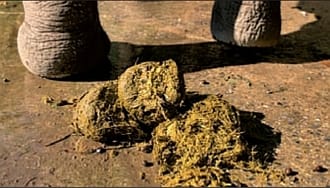 Circus elephants are believed to have been indirectly responsible for a large outbreak of the notorious pest plant Alternanthera philoxeroides, or Alligator weed, an immersed aquatic plant that originated in S. America.
The 4 Ha outbreak at Hamilton city was found in April by a spray contractor. During discussions with the landowner about the find, council biosecurity staff learnt from him that the weed started sprouting after a load of elephant dung was purchased as a fertiliser from a circus that visited Hamilton in 2007.
Apparently 60% of what elephants eat is excreted virtually untouched. Alligator weed is fairly common in Northland and often turns up in cheap hay or silage from there, and it was clearly possible the elephants had consumed such feed. Subsequently, historic circus sites across Hamilton have been checked for alligator weed with nothing found so far. Since alligator weed is a “total control pest plant” to be eradicated anywhere in the region, the council has begun work to remove it, with work expected to carry on for a number of years.
Source :- Waikato Regional Council promoting Biosecurity Month
-
Australia: Bird strikes an increasing problem in Queensland
The Australian Transport Safety Bureau has expressed concern at the high number of bird strikes at Australian airports, with almost 1800 recorded in 2011 and Brisbane Airport recording almost 80 bird strikes so far this year.
With pests such as ibises quickly adapting to loud sounds aimed at scaring them away from airports – wildlife control experts say they continually have to find innovative new forms of avian agitation. Gold Coast company Naturecall Environmental which looks after Brisbane Airport recently gained the Australian rights for the Bird Banger and Screamer Siren from American company Reed Joseph, which also supplies bird control products to the US armed forces and Kennedy Space Centre.
These two new weapons are fired from a handgun-like launcher and the pyrotechnic cartridges explode in the sky to ruffle the feathers of pesky birds and send flying foxes batty. Despite all the hi-tech gizmos, Naturecall pest management expert Calista Cameron said simple measures often worked best. I’ll get out there and crack my whip or unleash Molly the kelpie to chase and bark at the birds,’’ she said.
Source :- news.com.au
-
USA: University of Florida takes on pest traceability
Fortunately for Florida berry growers, 2013 appears to have brought lower levels of spotted-wing drosophila, an invasive fly native to East Asia. The drop in population, however, comes after a harsh learning year for the U.S. state and a push to safeguard the industry against the potentially devastating pest.
Since its first detection in Florida in 2009, spotted-wing drosophila has spread to 28 counties in the state. In 2012, the presence of the fly dealt a significant blow to growers. The necessity for strong pest management comes from the reality of what could otherwise occur.
Management techniques at the farm level manifest in a number of ways, from biological control, to pesticides, to community monitoring networks. The University of Florida is working with growers not just to control such pests, but to understand their origin. Among efforts to understand the spread of pests is the development of a database to improve traceability. In addition the university is also working to prevent agricultural threats from leaving their point of origin. The Caribbean Distance Diagnostic System is working to set up resources for pest management in a region known to be a major pathway. The idea is to create targeted intervention and ease the strain of detecting pests once they arrive to Florida entry points.
Source :- Fresh Fruit Portal
-
New Zealand: Rat plague bigger than ever
Rat infestations of Otago homes have kept exterminators busier than ever. David owner of McPhee Pest Management Services of Dunedin, said the hot summer was ideal for rats to breed and the cold winter had an ‘’influx of rodents’’ seeking shelter indoors. Rats were as cunning as ever, he said. ‘’We put an infrared camera in a roof and watched them taking bait from a trap and not setting the trap off.’’ Procare owner Paul Corkin, also of Dunedin, said he had been exterminating rats for nearly 20 years and his pest-control business was busier than usual.
Rats in a Central Otago farm house had eaten 20kg of bait in a week, he said. The rodents then ate another 15kg the following week and 10kg the week after, he said. ‘’They had quite a problem, when you consider that 20g kills a rat.’’ Target Pest South Island director Kurt Loklindt said he had exterminators working across Otago.
The rats were the same size as in past years but if a rat lived in freezer panels, it could appear to be larger, because the cold made its hair grow longer.
It was unusual to find a rat that weighed more than 1kg, he said. A house on a rural block was three times more likely to be infested with rats than an urban house because in the country, a rat had better environment in which to breed, he said.
Source :- News: Dunedin
-
Kenya: African nations increase efforts in sound management of hazardous chemicals
At the beginning of July, meeting at the headquarters of the UN Environment Programme (UNEP) in Nairobi, Kenya, delegates from 28 African countries a draft roadmap aimed at driving the continent towards meeting the 2020 goal of the sound management of chemicals across their lifecycles.
“The roadmap will assist African countries to accelerate the integration of management of chemicals into national development planning, a key component of chemicals and waste financing as agreed by UNEPs Governing Council earlier this year,” said Tim Kasten, Head of UNEP’s Chemicals Branch. Zambia, Burkina Faso and Uganda presented newly developed national draft roadmaps for their countries on raising the awareness of the need for sound management and the development of the enabling legal frameworks.
The Strategic Approach to International Chemicals Management (SAICM), adopted in 2006, recognizes that developing country progress towards the goal “to ensure that, by the year 2020, chemicals are produced and used in ways that minimize significant adverse effects on the environment and human health” requires an integrated lifecycle chemical management strategy. In particular SAICM emphasizes the need for enhanced coherence, consistency and cooperation in national chemical management legal and institutional arrangements, backed by secure and predictable finances. The challenge facing Africa is particularly urgent given that UNEP’s Global Chemicals Outlook report projects drastically increased chemical use, production and disposal in developing nations in the coming years, on top of significant increases over recent decades.
Source :- UNEP News Centre, 4 July 2013
-
Europe: Crop protection industry joins fight against food waste
The European Crop Protection Association has joined more than a dozen other organizations in signing the “Every Crumb Counts” declaration against food wastage. Sponsored by FoodDrinkEurope, the declaration calls on stakeholders all along the food chain – from farm to fork and beyond – to take further action to prevent and reduce edible food wastage on a European and global scale. The aim is to halve EU edible food waste by 2020.
Pesticides and other plant science innovations boost crop yields, minimise pre- and post-harvest losses and improve the efficient use of natural resources such as land, water and energy. These products ensure that high quality, affordable food reaches the consumer. A recent OECD-FAO report found that without advanced pest management, current annual losses of between 26% and 40% of the world’s potential crop production could double.
Read more about the declaration at:- www.everycrumbcounts.eu
-
Sweden: Anticimex acquisition of parts of ISS Pest Control successfully closed
On May 31, Anticimex announced that the acquisition of ISS Pest Control businesses in Australia, Austria, Belgium, Denmark, Germany, Italy, the Netherlands, New Zealand, Norway, Portugal, Spain and Switzerland has been approved by the relevant competition authorities.
Anticimex acquires 100% of the shares in the businesses, including ISS washroom businesses in Australia, Italy and New Zealand. The new group´s name is Anticimex, with more than 3 000 employees, serving around 2.2 million customers. In 2012, the combined pro-forma sales amounted to approximately SEK 3.2 billion (EUR 385 million). Anticimex was founded 1934 in Sweden and is today an international service company providing services that include pest control, food hygiene assurance, dehumidification, fire prevention as well as property inspections and energy surveys.
The company serves customers within both the commercial and residential sector. Anticimex has its own distribution channels as well as franchise networks and partners, e.g. insurance companies and real estate agents, and is headquartered in Stockholm, Sweden.
Source and contact :- Anticimex Olof Sand, CEO Anticimex, olof.sand@anticimex.se
-
USA: Asian pests set to devastate local tree species
Invasive pests, Emerald Ash Borer and Hemlock Woolly Adelgid, were both recently found in the Allegheny National Forest, where they are poised to devastate tree species. Allegheny National Forest silviculturist Andrea Hille said there is no effective treatment for the Emerald Ash Borer, which is now present in 18 states across the country. “We will continue to monitor it, but at this point I would say the Ash trees are on their way out. “Now, we’re collecting ash seed for long-term storage at the National Seed Storage Laboratory so its genetic diversity can be conserved for possible reintroduction if the emerald ash borer is ever brought under control in the U.S.”.
Similar to the demise of the American Chestnut in the 1930s, the adelgid has caused the death of 80 percent of hemlocks along the Blue Ridge Parkway in the last 10 years and in Shenandoah National Park since the late 1980s. The oldest hemlock tree in Tionesta is more than 500 years old and in Cook Forest is about 350-years-old.
Warnings are out to remind people not to move firewood or tree material that has not been treated to prevent further spread of the pest.
Source :- The Bradford Era, Pennsylvania.
-
Australia: Weevil control must be monitored
Identifying crop weevil species is an important step for growers when implementing integrated pest management (IPM) practices. Weevils, which are commonly found in a wide range of grain crops and can be found in minimum tillage and stubble retention farming systems, feed on vegetative parts of crop plants, often leaving scalloped-shaped holes along the edges of leaves. The Grains Research and Development Corporation’s The Back Pocket Guide: Crop Weevils has been designed to assist growers identify the most common weevils found in the southern and western cropping regions. Growers can monitor their crops and gauge population levels, to help inform them on the best control decision.
Damage from weevils can occur at any time of the growing season, but feeding during the early part of the growing season is typically the most critical. Seedlings should be continuously monitored from autumn to winter for any major root damage by weevil larvae. Then in spring growers are advised to look for signs of chewing damage on plants as well as a loss of plant vigour.
To download The Back Pocket Guide:- Crop Weevils go to: www.grdc.com.au/GRDC-BPG-CropWeevils.
-
USA: Enhanced pheromone lure proves irresistible to orchard pest
Codling moths are major pests of apples, pears and walnuts and historically, growers have sprayed their orchards with insecticide to prevent the larvae from attacking the fruit.
Lures baited with synthetic versions of the female moth’s sex pheromone, have helped growers refine their timing of insecticide and reduce the amount applied. As part of research to improve the technology further, a team research team from ARS has identified and synthesized new compounds to use with the sex pheromone.
A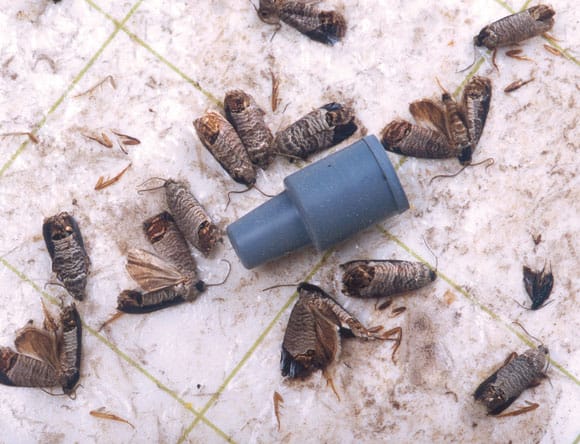 mong these are pear ester, the characteristic aroma of ripe pears, and acetic acid that makes vinegar tangy. Pear ester alone is a potent attractant for both sexes of codling moth.
Adding acetic acid significantly increases the number caught. However, the team found that the most powerful lure resulted from combining pear ester, sex pheromone and acetic acid. The team’s studies indicated that the combined lure can capture eight to 10 times more female moths than using the pear ester-pheromone combination alone.
Using lure-based monitoring tools, the researchers also developed action thresholds based on both female and total moth catches that enabled growers to reduce their pesticide applications by 30 to 70 percent.
Orchard-scale trials are under way to find out whether combining the pear ester-pheromone lures with acetic acid can effectively be used to monitor apple leafrollers, which are important secondary pests.
Source and Contact :- ARS. david.nicholson@ars.usda.gov
-
And finally…
Cicada hysteria gripped the US in June. After 17 years buried in the soil, the periodic cicadas emerged with the hot summer weather. Known as Brood II, they were born in 1996, burrowed into the ground and lived as nymphs, living on tree sap until they emerged.
Cicada biology is focused around maintaining large population sizes, to overwhelm their predators with such huge numbers that it’s impossible for their entire population to be eaten.
Fortunately periodical cicadas don’t travel very far, with 12 broods in the eastern US that have a 17-year life cycle, and 3 that mature every 13 years. Each group tends not to overlap.
See :- www.cicadamania.com
Published in International Pest Control – July/August 2013 issue
Category: International Pest News, news in brief