


International Pest Control – November/December 2025 – Vol 67, Nr.6

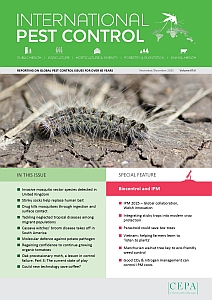 The vectors of multiple diseases including dengue, chikungunya and Zika, posing a public health risk to populations, have now been detected in Southern England, another benefit of global warming: “Send not to know for whom the bell tolls…” And global food
systems will need a major overhaul if we are to mitigate climate change, stop biodiversity loss and avert a crisis, according to a paper recently published in Nature. Hopefully AI, biotech and the kind of investment the James Hutton Institute has received can help. And if you have any stinky socks, consider their research potential before putting them in the wash – according to Sightsavers they have their uses.
Our pest of the issue is the booklouse, the bane of historic libraries but best controlled using environmental factors – especially humidity. We report on an upcoming conference on Fungicides, the 2025 Global Pest Management Conference in Lagos and Pestworld 2025.
In company news its once again the merry-go-round of mergers, acquisitions, upgrades and new products. Insect Science has made it to Koppert’s preferred supplier, Biobest has upgraded its Side Effects app to display the impact of a product on beneficials, camera technology has been integrated at Microshare and Tactacam, and Rentokil has won Innovation of the Year with its AI powered pest monitoring and identification tool. Biofirst Group has launched Bioworks in Europe, Syngenta is using AI to identify the best vegetable varieties for a grower’s situation, Babolna Bio is celebrating 60 years, Groupe Berkem has launched its first biosolution for the agricultural sector and BASF has expanded access to its field management tool.
In our special feature section on Biocontrol and IPM we report on the “New IPM 2025” conference in Swansea, UK. We look at the integration of sticky traps into IPM, how a parasitoid could save the box, how in Vietnam IPHM (integrated plant health management) has boosted yields by 10% while cutting pesticide use by 40%, the possible role of the Manchurian walnut tree in pest control and, last but not least, how CO2 and nitrogen management can control IPM costs.
In public health we look at the evolution of malaria vectors in response to control efforts, how a drug can kill mosquitoes, mosquito hot spots in Brazil, neglected tropical diseases and how worker’s gut bacteria are impacted by pesticide application.
In Agriculture cassava witches’ broom is a problem to be tackled, dicamba damage in soya can now be assessed by satellite, a genetic discovery could lead to peanut varieties better suited to a warmer planet, and regen agriculture gets the thumbs up from CABI. A new variety of tomato rootstock resistant to root-knot nematodes is impressing farmers and giving them the confidence to bring back organic tomatoes.
In Forestry we have part 3 of Dr Terry Mabbett’s series on OPM, we look at how Norway spruce needs protection from insects and fungi, the resurgence of the Yellowstone aspen, British ash woodland fighting back against ash dieback, and how tree mixes can enhance forestry growth.
Also in this issue is our plan of Special Features for 2026 so if you have an interest in contributing to any of the topics do contact me – we like articles to be a multiple of 600 words (one page) up to a maximum of 2,400 words. No advertorial, just good science about your products or about a paper you have recently published that has practical implications for pest control in its widest sense.
Chris Endacott, Editor International Pest Control magazine
editor@international-pest-control.com
Contents International Pest Control November/December 2025
Volume 67, Number 6.
 INTERNATIONAL NEWS
- Invasive mosquito vector species detected in United Kingdom
- AI and biotech driving the next revolution
- Overhaul global food systems to avert crisis
- James Hutton Institute receives a £3 million investment
- And finally… Stinky socks help replace human bait
 PEST OF THE ISSUE
- Booklouse
 ASSOCIATION & SOCIETY NEWS
- 21st International Reinhardsbrunn Symposium on Modern Fungicides & Antifungal Compounds
- Global Pest Management Conference (GPMC) 2025, Lagos
- PestWorld 2025 breaks all records
 COMPANY NEWS
- Insect Science now Koppert’s preferred semiochemicals supplier
- Biobest’s upgraded Side Effects app safeguards beneficials
- Microshare and Tactacam integrate cellular camera technology
- Rentokil Pest Control wins the Innovation of the Year Award
- BioWorks enters European market
- AI to identify the best vegetable varieties for growers
- Babolna Bio celebrates its 60th anniversary
- Groupe Berkem launches OPSeed75
- NOVATERM® helps PMPs detect termite activity
- BASF expands global availability of xarvio® FIELD MANAGER
 SPECIAL FEATURE: Biocontrol and IPM
- IPM 2025 – Global collaboration, Welsh innovation
- Integrating sticky traps into modern crop protection
- Parasitoid could save box trees
- Vietnam: helping farmers learn to ‘listen to plants’
- Manchurian walnut tree key to eco-friendly weed control
- Good CO₂ & nitrogen management can control IPM costs
 PUBLIC HEALTH
- Genomic evolution of malaria transmitting mosquito
- Drug kills mosquitoes through ingestion and surface contact
- How gut bacteria change after exposure to pesticides
- Tackling neglected tropical diseases among migrant populations
- Mosquito-borne disease hotspots predicted in Brazil
 AGRICULTURE
- Cassava witches’ broom disease takes off in South America
- Detecting soybean dicamba damage from the sky
- Genetic discovery could help peanuts beat global warming
- Molecular defence against potato pathogen
- Regenerative agriculture highlighted as a transformative approach
 HORTICULTURE & AMENITY
- Regaining confidence to continue growing organic tomatoes
- East-West divide in lettuce pest threatens UK crop yields
 FORESTRY & PLANTATION
- Oak processionary moth, a lesson in control failure. Part 3: The current state of play
- Could new technology save coffee?
- Norway spruce protection against insects & fungal infestation
- Yellowstone aspen showing signs of recovery
- British ash woodland is evolving resistance to ash dieback
- The right tree mix enhances forest productivity & services
 CALENDAR
- Upcoming pest control events
Published in International Pest Control – November/December 2025 issue.
Category: Issue Editorial & Contents


