


International Pest Control – January/February 2026 – Vol 68, Nr.1

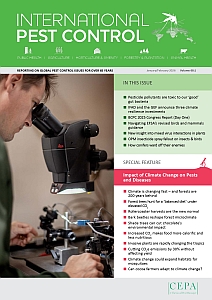
Cover image: Insect Science®’s analytical chemist Dr Bouwer working on the GC-EAD instrument – where an insect antenna is connected to an electroantennogram detector.
Picture by Derius Erasmus
As if chemical pesticides are not under enough pressure, a team led by the University of Cambridge tested the effect of 1,076 chemical food contaminants including herbicides and insecticides on 22 species of gut bacteria. 168 were found to be toxic and the data is now being used to predict if industrial chemicals will be harmful to human gut bacteria.
On the plus side, Sustainable Crop Management (SPM) would have positive effects across the globe and, according to Production Economics Group at the University of Bonn, the key will be supporting farmers during this transformation by offering them effective alternatives for crop protection.
Monsanto is a step closer to the US Supreme Court establishing if companies, having complied with federal warning label requirements, should be punished under state laws. This is a general principle that will apply to a wide range of products, not solely glyphosate.
The Special Feature this issue is about the impact of climate change on our industry and an early entry on the topic is the news that IFAD and GEF have announced climate resilience investments. Our Pest of the Issue is the Cluster Fly – more of a nuisance than harmful pest – but still one that must be controlled.
The BCPC Congress is a regular winter feature: we cover the first day in this issue with day 2 appearing in the next issue. So many topics: hopefully some are of interest! Lots of conferences are coming up in 2026 covering topics as wide as Photosynthesis and Bystander Exposure.
We have plentiful news from the industry, many are regulars in this section: Koppert, Bayer, BASF, ADAMA, Syngenta, Tyro Group, WUR, Amoéba, M2i, Noble Seeds and as usual it is all about new products, partnerships and acquisitions.
The subject of our company profile is South African company Insect Science®. Deeply involved in the semiochemical market, from foundational research to final application, Insect Science aims to prove that the smallest chemical signals can lead to big advances in sustainable farming.
So to the climate change special feature: we have ten articles for you with topics ranging from the enhanced spread of vectors of disease to the adaptation of crops and trees. We’re also seeing the negative impacts of climate change with failed or poor harvests which may mean more expensive food for you and me but poverty for some farmers. Even the nutritional value of crops can be changed – inevitably for the worse. All ten articles are supported by peer reviewed papers and there were many more contending for space.
We have a fascinating introduction to the complexities of EFSA’s revised birds and mammals guidance provided by Jennifer Duncan of Sagentia Regulatory. We look at virus interactions, a metabolic model for potatoes that could lead to increased yield and less pesticide use, a wheat crop that can make its own fertiliser and more nutritious rice made with less fertiliser.
Our own Terry Mabbet finalises his four-part look at OPM in the UK and the impact on insects and birds. Then we move from oaks to cacao, on to citrus, back to chocolate – and this time coffee too. We finish with a piece on how conifers fight their enemies. We end with our 2025 index.
We have a new selection of Special Features for 2026 – if you or your organisation want to write an article for any of them just let me know. Finally, you might notice we have a new team member, Deputy Editor Maria Elisa Leandro. She will hopefully be taking over some of the work from me for future issues and we will have a full introduction in the next issue. New to our Technical Consultant team is Raja Mahandran and we look forward to his contributions.
Chris Endacott, Editor International Pest Control magazine
editor@international-pest-control.com
Contents International Pest Control January/February 2026
Volume 68, Number 1.
 INTERNATIONAL NEWS
- Pesticide pollutants are toxic to our ‘good’ gut bacteria
- SPM would have positive effects across the globe
- US Supreme Court decision to review the Durnell case
- IFAD and the GEF announce three climate resilience investments
 PEST OF THE ISSUE
- Cluster fly
 ASSOCIATION & SOCIETY NEWS
- BCPC 2025 Congress Report (Day One)
- BIOKET 2026
- Photosynthesis 2026
- Spore to Store – Urban Mushroom Symposium
- Plant BioProTech 2026
- PestEx 2026: The UK’s biggest pest control industry event
- Worker, Operator, Bystander and Resident Exposure and Risk Assessment
 COMPANY NEWS
- Gold Award for the sustainable hive
- New European forestry business support manager
- BASF celebrates five years of Selontra® rodent control
- Tyro Group expands in USA with acquisition of EnviroSMART
- Partnership to co-develop Gilboa® fungicide
- WUR biological pest control professorship extended
- CRD lifts restriction for Bayer’s Iblon® fungicide
- Natural breakthrough in protecting cereals
- Long-term partnership for M2i Group & Pherobio
- India: BASF Nunhems to acquire Noble Seeds
 COMPANY PROFILE
- Insect Science®: Semiochemical strategies for pest control
 SPECIAL FEATURE: Impact of Climate Change on Pests and Diseases
- Climate is changing fast – and forests are 200 years behind
- Forest trees hunt for a ‘balanced diet’ under elevated CO2
- Rollercoaster harvests are the new normal
- Bark beetles reshape forest microclimate
- Shade trees can cut chocolate’s environmental impact
- Increased CO2 makes food more calorific & less nutritious
- Invasive plants are rapidly changing the tropics
- Cutting CO2 e emissions by 30% without affecting yield
- Climate change could expand habitats for mosquitoes
- Can cocoa farmers adapt to climate change?
 AGRICULTURE
- Navigating EFSA’s revised birds and mammals guidance
- New insight into mixed virus interactions in plants
- Growth or defence: how to increase potato yield
- Wheat that makes its own fertilise
- How to grow more nutritious rice that uses less fertiliser
 FORESTRY & PLANTATION
- OPM insecticide spray fallout on insects and birds
- Crossbreeding produces disease-resistant cacao plants
- Mysterious tubular structure in citrus pest symbionts
- Coffee and chocolate are under threat
- How conifers ward off their enemies.
 CALENDAR
- Upcoming pest control events
 INDEX
INDEX
- International Pest Control Index Volume 67 – 2025
Published in International Pest Control – January/February 2026 issue.
Category: Issue Editorial & Contents


