


Himalayan Balsam and its control on the River Monnow in Herefordshire and Monmouthshire
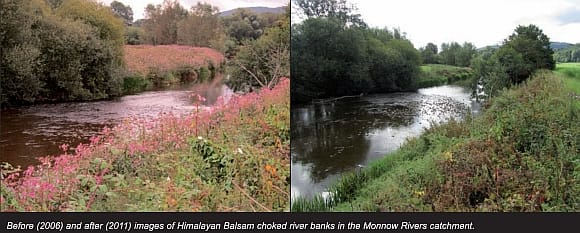
Himalayan Balsam Impatiens glandulifera is sometimes cultivated for its flowers but is now widely established in counties such as the British Isles and the United States and in some situations has become an invasive species weed. Aggressive seed dispersal, coupled with high nectar production which attracts pollinators, often allows the Himalayan Balsam to outcompete native plants. In the UK, the plant was first introduced in 1839 at the same time as Giant Hogweed and Japanese Knotweed.
These plants were all promoted at the time as having the virtues of “herculean proportions” and “splendid invasiveness” which meant that ordinary people could buy them for the cost of a packet of seeds, to rival the expensive orchids grown in the greenhouses of the rich. Within ten years, however, Himalayan balsam had escaped from the confines of cultivation and begun to spread along the river systems of England. Today it has spread across most of the UK and Himalayan balsam is now a naturalised, annual plant, found especially on riverbanks and in waste places where it has become a problem weed.
It is a tall growing annual, 2-3m (6-10ft) in height. Between June and October it produces clusters of purplish pink (or rarely white) helmet-shaped flowers. It tolerates low light levels, shading out other vegetation and so gradually impoverishing habitats, by shading out other plants. When it dies off at the first frost, it leaves bare river banks that are more prone to erosion.
The flowers are followed by seed pods that open explosively when ripe, each plant producing up to 800 seeds, which are dispersed widely as the ripe seedpods shoot their seeds up to 7m (22ft) away. Once established in the catchment of a river, the seeds which can remain viable for only two years, are transported further afield by water or, in some cases, by getting caught in animal fur/wool and in mud or soil on tyres and or loads such as potatoes.
The weed has no natural predators, however grazing livestock do eat and trample it and, in reasonably intensive numbers, sheep and cattle can keep it under control….
This is a preview of a full article published in International Pest Control – July/August 2013 issue.
View full article online
The full text of this article is available to subscribers of International Pest Control.
Subscribe for online access
Subscribe to International Pest Control for full online access to all articles in every issue since 2004.
Author: Robert Denny.
Project Officer, Monnow Rivers Association. For more infomration visit www.monnow.org
Category: Horticulture-Amenity