


Plant-parasitic nematodes: WUR launches major project
Climate change and genetic selection have brought root-knot nematodes further north in Europe and made cyst nematodes more difficult to control. These emerging parasites threaten major crops such as tomato and potato. To get a clear picture of the proliferation of novel nematode species and populations and to find appropriate and sustainable solutions to these problems, WUR is launching a major research and innovation project with seventeen European partners called NEM-EMERGE. The project has been accepted as a Horizon Europe Project, resulting in 7 million euros in funding.
Root-knot and cyst nematodes form a grievous threat to tomatoes and potatoes. These nematodes occupy places one and two in the ranking of the most impactful plant-parasitic nematodes. WUR researcher Hans Helder explains how these nematodes work. ‘They drain energy from the plant, causing a plant condition referred to as ‘fatigue’.
As a result, the crop barely grows and is severely weakened leading to crop loss and hence economic damage. Annually, root-knot nematodes alone cause yield losses of several billion euros. Next to crop rotation and resistant varieties, growers currently use broad-spectrum chemicals to control these nematodes which have unwanted negative side-effects on nature and the environment.’…read more download PDF.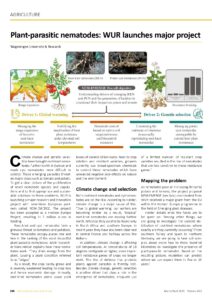 Published in International Pest Control – March/April 2024 issue.
Subscribe to International Pest Control magazine
Subscribers have free online access to all articles from 2004.
Category: Agriculture