

International Pest Control – May/June 2026 – Vol 68, Nr.3

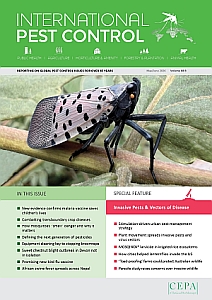
Cover Image: An invasive spotted lanternfly feeds on tree sap using piercing mouthparts, a behaviour driving widespread damage to economically important hosts such as grapevines and maples in the northeastern United States.
Picture by New York University
It is great to be able to report some good news, and the latest evaluation of the RTS.S malaria vaccine confirms it is saving the lives of young children in Ghana, Kenya and Malawi. And the additional health visits associated with the four-dose vaccine also allow for the delivery of other childhood vaccines.
CABI and Uganda are getting together under a Host Country Agreement to transform the country’s agriculture and particularly phytosanitary issues while the FAO/IAEA Centre of Nuclear Techniques in Food and Agriculture, has launched a five-year Coordinated Research Project (CRP) to strengthen plant health preparedness using nuclear and related technologies. On the bad news scales, we hear that the global fertiliser scarcity caused by disruptions in the Strait of Hormuz will lead to lower yields and tightening food supplies in the latter half of 2026 and into 2027.
The silverfish, scourge of kitchens and bathrooms – anywhere damp and warm – is our Pest of the Issue.
Company News covers SugaROx, BASF, PelGar, Koppert, Biobest and Syngenta with a mix of new investments, plant, team members, CEOs, packaging and a new herbicide as well as a new approval for pine weevil control.
In our Special Features section we look at Invasive Pests and Vectors of Disease with contributions on cockroach control from one of our Technical Consultants, David Liszka of BioLogical; managing phytosanitary threat from Dr Emilia Mikulewicz of Cultiva EcoSolutions; malaria vector control from Russell IPM as well as the Directorate of Health Services, The Gambia; managing the spread of spotted lantern fly in the US; toad proofing Australian farms and we finish with the scary idea that the spread of non-native wildlife can also spread pathogens of both veterinary and zoonotic importance.
In Public Health we look at a new compound that acts against Plasmodium vivax, the predominant malaria species in Brazil, during three phases of the disease cycle, eliminating the asexual form of the parasite from human blood and liver, and preventing transmission to mosquitoes. We also report on ticks in New York State, USA and the ability of mosquitos to smell danger.
In agriculture we report that the mapping of rice stink bugs at a genetic level is being used to improve the control of a pest that costs American rice farmers $millions in lost production. What is a “green pesticide”: a team of Brazilian researchers have tried to answer that question with a focus on the use of nanotechnology. Avoiding stream pollution is important and recent research at Penn State has found that some pesticides can avoid anti-pollution structures. We finish with a look at the use of predatory nematodes to reduce the impact of root-knot nematodes on bananas in Guam.
Not having any soil is not a problem for lettuce growers in southern Grenada according to the recent FAO report. In a climate adaptation project, family farmers have set up a low-cost hydroponic system. The simple way to control broomrape is to clean your equipment and in particular field equipment removing mud, soil, plant material or anything that can collect and carry broomrape seeds.
IPC Technical Consultant Dr Terry Mabbett reviews the current situation regarding the Sweet chestnut blight outbreak in Devon, UK. We hear from a team at Purdue University on how a vaccine might be used to control the fertility of feral horses as well as deer and swine and look at the search for cost effective pinewood nematode control and the impact of fast-growing non-native trees on biodiversity.
Finally, we conclude with a flurry of Animal Health articles on a bird flu vaccine, bird flu risk in cattle, swine fever spread in Nepal, and the use of air sampling to detect viruses.
In the next issue the Special Feature will be all about Developments in Glasshouse Pest Control – as ever your contributions would be most welcome!
Chris Endacott, Editor International Pest Control magazine
editor@international-pest-control.com
Contents International Pest Control May/June 2026
Volume 68, Number 3.
 INTERNATIONAL NEWS
- New evidence confirms malaria vaccine saves children’s lives
- CABI and Uganda expand commitment to agricultural transformation
- Combatting transboundary crop diseases
- Fertiliser scarcity will affect next harvests and food supplies
 ASSOCIATION & SOCIETY NEWS
- BCPC Congress – Registration now open
 PEST OF THE ISSUE
- Silverfish
 COMPANY NEWS
- SugaROx secures £2.5 million investment
- BASF commissions new fermentation plant
- PelGar International: Asia Business Manager Role
- Koppert appoints Hans Peters as CEO
- New packaging advances aphid control
- PelGar appoint Andrej Branc Head of Global Sales
- A global breakthrough in controlling grass weeds
- €40m invested in seed processing facilities
- Lanzarta approval to target Hylobius pine weevil control
 SPECIAL FEATURE: Invasive Pests & Vectors of Disease
- Stimulation-driven urban pest management strategy
- Plant movement spreads invasive pests and virus vectors
- MOSQINOk® larvicide in irrigated rice ecosystems
- How cities helped lanternflies invade the US
- ‘Toad-proofing’ farms could protect Australian wildlife
- Parasite study raises concerns over invasive wildlife
 PUBLIC HEALTH
- Synthetic compound promising against malaria spread
- Ticks carrying multiple pathogens rise in Northeast US
- How mosquitoes “smell” danger and why it matters
 AGRICULTURE
- Rice stink bug mapping offers control clues
- Defining the next generation of pesticides
- Some pesticides evade stream protection
- Predatory nematodes may protect Guam crops
 HORTICULTURE & AMENITY
- No soil, no problem: farming smarter in Grenada
- Equipment cleaning key to stopping broomrape
 FORESTRY & PLANTATION
- Sweet chestnut blight outbreak in Devon not in isolation
- Vaccine offers new tool for wildlife control
- Finding cost effective pinewood nematode control
- Fast-growing trees could destabilise forests
 CLIMATE CHANGE
- Tropical insects face growing climate risks
 ANIMAL HEALTH
- Promising new bird flu vaccine
- w tool predicts bird flu risk in cattle
- African swine fever spreads across Nepal
- Air sampling improves virus detection
 CALENDAR
- Upcoming pest control events
Published in International Pest Control – May/June 2026 issue.
Category: Issue Editorial & Contents